Tuesday, May 17, 2011

5.13 i can describe catalytic cracking of long-chain hydrocarbons


a. Define the term catalyst

A substance that increases the rate of a chemical reaction without itself undergoing any permanent chemical change.

b.Why is a catalyst used?
To speed up the rate of reaction
c. Why are high temperatures needed?
To separate the hydrogens and the carbons, also high temperatures help speed up the reactions

d.
1. What is the process called when you break long chained hydrocarbons in to shorter ones?
Cracking
2. Why is the catalyst used in this experiment?
The catalyst will speed up the reaction  
3.  How is Paraffin broken down?
By applying heat onto the Paraffin
4.  How is the Paraffin Collected?
Over water and into a test tube facing down into the water
5.  What is the main thing you have to try and avoid in this experiment?
Water sucking back up the tube and into the test tube 
6.  Why is this dangerous?
Allowing the water to suck back and into the hot test tube would turn the water into steam and this may cause an explosion
7. Why aren't the first few bubbles produced collected in the experiment above?
This is because the first few bubbles are formed by the air inside the test tube expanding not the Paraffin.
8. Why do we crack long chained hydrocarbons
This is because most long chained hydrocarbons are useless and we get a lot of this material from fractional distillation and not enough of the short chained hydrocarbons which are more useful to us. This is why we crack the long chained hydrocarbons to produce the more useful short chained hydrocarbon.  


5.12 I can recall the problems associated with the fractional distillation of Crude oil

a. When crude oil undergoes fractional distillation there are too many large chain hydrocarbons (eg Bitumen) produced and not enough short chain hydrocarbons (eg refinery gasses)
b. To solve these problems the long chain hydrocarbons undergo a chemical reaction called cracking

5.11 I can recall how nitrogen oxides are formed in car engines


a.    Write the general equation for the combustion of a fuel
Fuel+Oxygen= Energy+Oxides 
b.      During combustion the nitrogen in air can react to form what gases?
Oxygen
c.       What condition is necessary for the formation of these gases?
High Temperatures
d.      In what common object is this condition found?
Car Engines 
e.      Why is this condition needed for nitrogen to react?
Because Nitrogen has a strong triple covalent bonds  
f.        What are the dangers of the products from this reaction?
Acid Rain 

Monday, May 16, 2011

5.7 I can describe how crude oil is separated

5.10 I can recall the problems associated with incomplete combustion


What are the properties of carbon monoxide?
Carbon monoxide is a colorless and orderless gas which can be fatal to humans 
Explain how carbon monoxide is formed?
Carbon monoxide is formed when there is incomplete combustion 
 Explain why carbon monoxide is poisonous?
Carbon monoxide it poisonous because it attaches itself to our hemoglobin faster than oxygen does
meaning that our cells won't have oxygen to use in respiration     

Tuesday, May 10, 2011

5.9 I can describe the trend in boiling point and viscosity of the main fractions


a.       What is the trend in boiling point of the fractions?
        The higher the boiling point of the fractions the slower it takes for the substance to boil out
b.      Define viscosity (source your definition)
      Resistance of a liquid to shear forces
c.       What is the trend in viscosity of the fractions?
        The higher the boiling point of the fraction the greater the viscosity of the fractions 
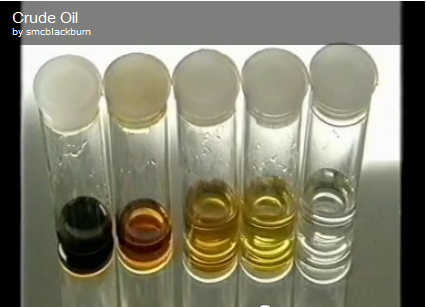
d.      What is the trend in color of the fractions?
        The higher the boiling point of the fraction the darker the color
e.      Why is crude oil separated into fractions?
        So that it is able to be used because Crude Oil by itself is useless 
f.        What process is used to separate crude oil into fractions?
      Fractional Distillation 
g.       What physical property allows this process to work?
      The different boiling points of each fraction 

Mnemonic for Fractional Distillation

Raging    Refinery Gases 
Golfers   Gasoline (Petrol)
Killed     Kerosene  
Dads      Diesel
Favorite  Fuel 
Bear       Bitumen